
In the rapidly evolving digital gaming landscape, the integrity of an online casino is not defined by its graphics or its welcome bonus, but by the regulatory framework that governs its operations. For technology professionals, affiliates, and discerning players, understanding the hierarchy of online casino licenses is critical. A license is more than a legal formality; it is a cryptographic and operational trust anchor. This article examines the technical and jurisdictional nuances of online casino licensing, providing a professional framework for evaluating operator legitimacy.
The Function of a License in Digital Gaming Architecture
From a technical perspective, an online casino license represents a regulatory API between a commercial entity and a sovereign jurisdiction. It defines the permitted operations, the required technical standards for random number generation (RNG), and the mandatory reporting protocols for financial transactions. Without a valid license, an operator is effectively a black box—unverifiable, unaccountable, and likely non-compliant with anti-money laundering (AML) directives.
Licenses are issued by regulatory bodies known as jurisdictions or authorities. These entities audit the operator’s software, financial solvency, and data protection measures. The strength of a license correlates directly with the stringency of the issuing authority’s technical audits.
Tier 1 Jurisdictions: The Gold Standard of Oversight
Tier 1 licenses are issued by highly respected, well-funded regulatory bodies primarily located in Europe and select offshore territories. These authorities enforce strict technical standards, including mandatory ISO/IEC 27001 certification for information security and frequent RNG testing by independent third parties such as eCOGRA or GLI.
- United Kingdom Gambling Commission (UKGC): Renowned for its rigorous technical audits, the UKGC mandates extensive responsible gambling controls and real-time data reporting. Operators must integrate with the national self-exclusion scheme, GAMSTOP.
- Malta Gaming Authority (MGA): A hub for European iGaming, the MGA requires detailed system documentation audits and continuous compliance monitoring. Its license is widely recognized as a passport to the European Economic Area.
- Gibraltar Regulatory Authority: Focused on high-stakes, high-turnover operators, Gibraltar enforces strict capital adequacy and cybersecurity standards.
For technology teams, a Tier 1 license signals that the operator has passed penetration testing, data segregation checks, and financial stress tests. It is a non-negotiable baseline for serious market participants.
Tier 2 Jurisdictions: Emerging and Regional Authorities
Tier 2 licenses offer a middle ground. These jurisdictions have established regulatory frameworks but may lack the enforcement resources or technical depth of Tier 1 authorities. They are often used by operators seeking to enter specific regional markets without the full overhead of UKGC or MGA compliance.
| Curacao (formerly Netherlands Antilles) | Four-tier license system (as of 2023 reform), low entry barriers, popular for offshore operators. | Basic RNG certification, AML policy submission, no mandatory local data residency. |
| Kahnawake Gaming Commission (Canada) | Long-standing offshore authority, focuses on First Nations sovereignty. | Independent audit of payout percentages, dispute resolution mechanism required. |
| Anjouan (Comoros) | Low-cost, fast-track licensing, often used as a stepping stone. | Minimal technical vetting, no mandatory penetration testing. |
Tier 2 licenses are not inherently untrustworthy, but they demand additional due diligence from players and partners. An operator with only a Curacao license may lack the data encryption standards or dispute resolution speed of a UKGC-licensed peer.
Tier 3 Jurisdictions: High-Risk and Unregulated Territories
Tier 3 licenses are issued by authorities with negligible technical oversight, or they are entirely fabricated by the operator. Common red flags include:
- License numbers that cannot be verified on the authority’s official database.
- Claims of licensing from defunct or non-existent bodies (e.g., “Government of Costa Rica” for casino operations—Costa Rica does not issue online casino licenses).
- No published RNG certificates or third-party audit reports.
Operating under a Tier 3 license is a critical vulnerability. It exposes the operator to arbitrary shutdowns, and it exposes players to non-payment, data breaches, and predatory terms. From a copywriting and technical due diligence perspective, any mention of a Tier 3 license should be treated as a disqualifying factor for serious B2B partnerships or high-value player acquisition.
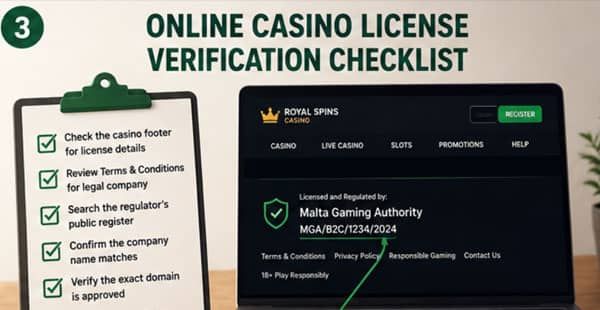
How to Verify an Online Casino License: A Technical Checklist
Verification is not a passive exercise. It requires active cross-referencing. Follow this ordered process:
The Technical Implications of License Portability and Multi-Jurisdictional Operations
Modern online casinos rarely operate under a single license. They employ a multi-license architecture, holding separate licenses for each market they serve. This creates technical complexity:
- Geo-blocking and geo-fencing: Operators must ensure players from non-licensed territories cannot access games. This requires IP intelligence and real-time geolocation APIs.
- Data residency and sovereignty: A UKGC license requires player data to be stored within the UK or in a jurisdiction with adequate data protection. A Curacao license has no such requirement.
- Currency and payment rail segregation: Multi-license operators must isolate fiat and crypto flows per jurisdiction to prevent commingling of regulated and unregulated funds.
For developers and compliance officers, the license is not a static document—it is a dynamic configuration file that dictates server locations, encryption protocols, and reporting frequencies. Ignoring license heterogeneity is a recipe for regulatory action and technical debt.
Conclusion: Licenses as Trust Infrastructure
In the absence of physical oversight, an online casino license is the primary trust signal in the digital economy. It is a cryptographic handshake between the operator and the rule of law. Tier 1 licenses provide strong guarantees of fairness, security, and recourse. Tier 2 licenses offer conditional trust. Tier 3 licenses offer none. For anyone building, promoting, or using online casino technology, the license is not fine print—it is the foundational architecture of legitimacy. Verify it. Audit it. Never assume it.